
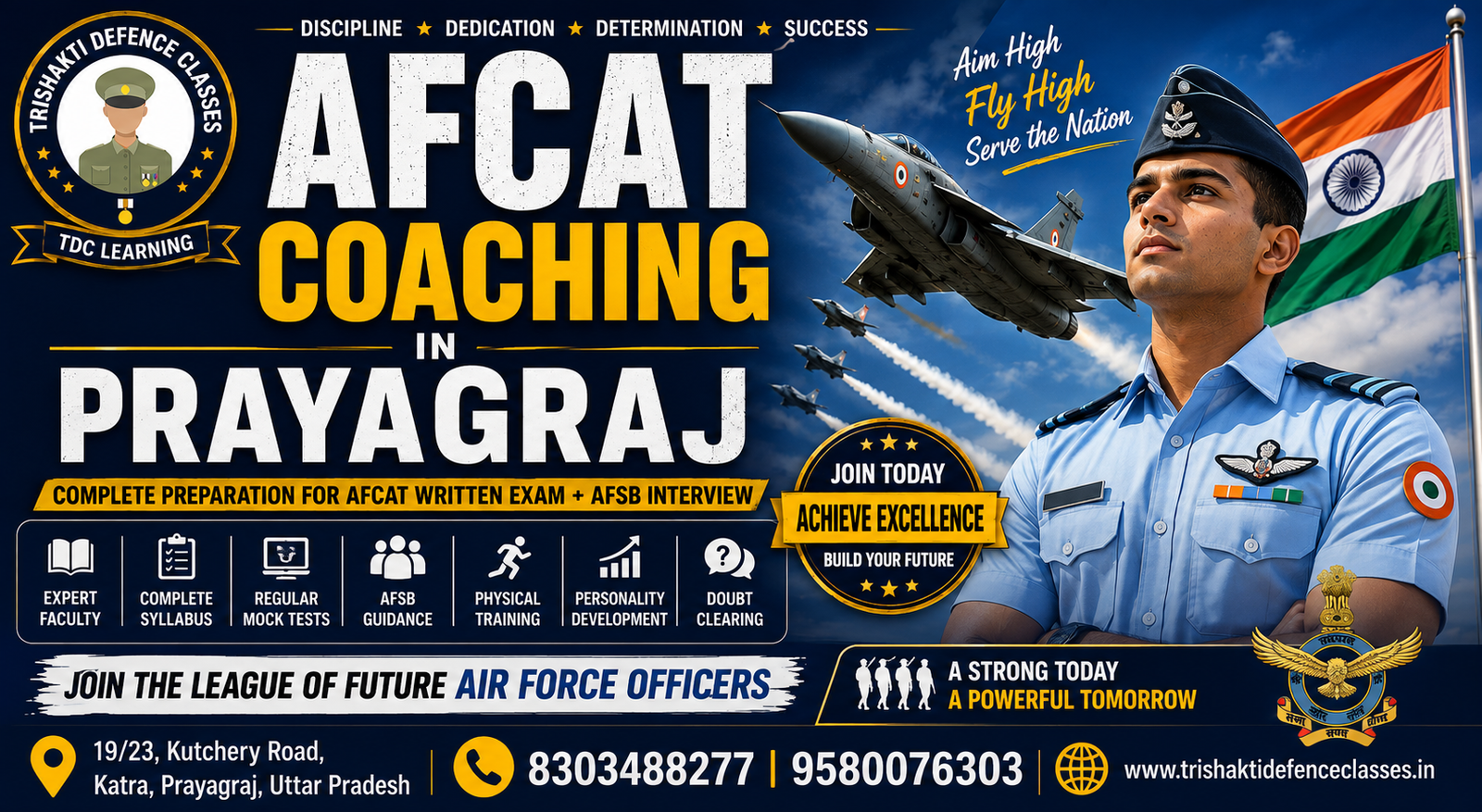
AFCAT Coaching in Prayagraj – Trishakti Defence Classes
If you are searching for AFCAT Coaching in Prayagraj, choosing the right institute can help you prepare systematically for both the AFCAT written examination and the subsequent AFSB stage. AFCAT is a major entry route for graduates who aspire to become officers in the Indian Air Force.
The Air Force Common Admission Test (AFCAT) is conducted by the Indian Air Force for recruitment to Flying and Ground Duty branches. The current IAF notification covers Flying, Ground Duty Technical and Ground Duty Non-Technical branches, along with applicable special entries.
Trishakti Defence Classes is a defence coaching institute in Prayagraj offering AFCAT along with NDA, CDS, SSB Interview, Air Force and Navy preparation. Its official website highlights experienced faculty, regular tests, study material, doubt support, AC classrooms, separate SSB classrooms and GTO training facilities.
Table of Contents
- What is AFCAT?
- Why Choose AFCAT as a Defence Career?
- AFCAT Eligibility Criteria
- AFCAT Educational Qualification
- AFCAT Age Limit
- AFCAT Exam Pattern
- AFCAT Syllabus
- AFCAT English Preparation
- AFCAT Numerical Ability Preparation
- AFCAT Reasoning Preparation
- AFCAT General Awareness Preparation
- AFCAT Selection Process
- AFSB Interview Preparation
- AFCAT Physical Fitness Preparation
- AFCAT Preparation Strategy
- Daily AFCAT Study Plan
- Common AFCAT Preparation Mistakes
- Why Choose AFCAT Coaching in Prayagraj?
- Why Choose Trishakti Defence Classes?
- Role of Y K Nittish Sir
- Role of Sangeeta Ma’am
- Frequently Asked Questions
- Contact Trishakti Defence Classes
- Conclusion
What is AFCAT?
AFCAT stands for Air Force Common Admission Test. It is conducted by the Indian Air Force to select eligible candidates for officer-level positions in different branches.
Through AFCAT, candidates can compete for opportunities in:
- Flying Branch
- Ground Duty Technical Branch
- Ground Duty Non-Technical Branch
The current IAF notification describes AFCAT candidates as Indian citizens, men and women, seeking appointment as Group A Gazetted Officers in Flying and Ground Duty branches.
AFCAT preparation therefore requires a combination of academic knowledge, speed, accuracy, current affairs awareness, communication skills, physical fitness and personality development.
Why Choose AFCAT as a Defence Career?
A career in the Indian Air Force offers an opportunity to work in a highly disciplined and professional environment while serving the nation.
AFCAT aspirants can work toward officer entries in areas such as:
- Flying
- Technical operations
- Administration
- Logistics
- Accounts
- Education
- Meteorology
- Weapon Systems
The exact branches and vacancies depend on the recruitment notification.
For example, the AFCAT 01/2026 notification included Flying, Ground Duty Technical and Ground Duty Non-Technical branches, with vacancies distributed between applicable Permanent Commission and Short Service Commission categories.
AFCAT Eligibility Criteria
AFCAT eligibility depends on the branch and recruitment cycle. Candidates must carefully read the latest official notification before applying.
For the AFCAT 01/2026 cycle, the Indian Air Force specified the following broad requirements.
Nationality
Candidates must be citizens of India under the applicable citizenship provisions.
Age Limit
For the AFCAT 01/2026 notification:
- Flying Branch: 20 to 24 years as on 1 January 2027.
- Candidates holding a valid and current DGCA Commercial Pilot Licence could receive the specified upper-age relaxation up to 26 years.
- Ground Duty Technical and Non-Technical Branches: 20 to 26 years as on 1 January 2027.
Age limits can change from one recruitment cycle to another, so candidates should always verify the current notification.
Marital Status
The AFCAT 01/2026 notification required candidates to be unmarried at the commencement of the course and stated that marriage is not permitted during training.
AFCAT Educational Qualification
Educational requirements vary according to the selected branch.
Flying Branch
For AFCAT 01/2026, candidates were required to have:
- At least 50% marks each in Mathematics and Physics at 10+2 level, and
- A minimum 60% graduation qualification or eligible BE/B.Tech qualification as specified in the notification.
Ground Duty Technical Branch
Technical candidates need the prescribed Physics and Mathematics background at 10+2 level along with an eligible engineering or technology qualification.
The list of accepted engineering disciplines is detailed in the official notification.
Ground Duty Non-Technical Branch
Educational requirements depend on the branch.
Eligible qualifications can include graduation in specified disciplines for areas such as:
- Weapon Systems
- Administration
- Logistics
- Accounts
- Education
- Meteorology
Candidates should check the exact qualification for the branch they want to apply for.
AFCAT Exam Pattern
The AFCAT examination tests candidates in multiple areas.
The current AFCAT notification specifies:
| Particular | AFCAT |
|---|---|
| Questions | 100 |
| Maximum Marks | 300 |
| Duration | 2 Hours |
| Mode | Online |
| Correct Answer | +3 marks |
| Incorrect Answer | -1 mark |
| Unattempted | 0 marks |
The examination covers:
- General Awareness
- Verbal Ability in English
- Numerical Ability
- Reasoning
- Military Aptitude
The current official notification confirms the 100-question, 300-mark structure and negative-marking scheme.
Why Negative Marking Matters
Because one mark is deducted for an incorrect answer, candidates should avoid blind guessing.
A good AFCAT strategy is:
Understand → Eliminate → Decide → Attempt
AFCAT Syllabus
English
The English section can include areas such as:
- Grammar
- Vocabulary
- Comprehension
- Synonyms
- Antonyms
- Sentence correction
- Error detection
- Idioms and phrases
- Sentence completion
Regular practice is the key to improving accuracy.
AFCAT English Preparation
English is an area where consistent daily practice can produce significant improvement.
Daily English Practice
Spend time on:
- Vocabulary
- Grammar
- Reading comprehension
- Error detection
- Sentence improvement
- Previous questions
- Mock tests
Improve Vocabulary
Maintain a vocabulary notebook.
For every new word, note:
Word → Meaning → Synonym → Antonym → Example Sentence
This method makes revision easier.
At Trishakti Defence Classes, Y K Nittish Sir – English Expert & Director provides English-focused guidance for defence aspirants.
AFCAT Numerical Ability Preparation
Numerical Ability requires both conceptual clarity and calculation speed.
Important topics include:
- Percentage
- Ratio and proportion
- Average
- Profit and loss
- Simple interest
- Compound interest
- Time and work
- Time, speed and distance
- Number system
- Algebra
- Mensuration
Best Way to Prepare
Use the following sequence:
Concept → Formula → Basic Questions → Advanced Questions → Previous Questions → Mock Test
Do not move to difficult questions before your fundamentals are strong.
AFCAT Reasoning and Military Aptitude
Reasoning preparation can include:
- Analogy
- Classification
- Series
- Coding-decoding
- Verbal reasoning
- Non-verbal reasoning
- Spatial ability
- Logical reasoning
- Pattern recognition
The objective is to improve both speed and accuracy.
Practice Tip
Set a timer while solving reasoning questions.
Gradually reduce the time required while maintaining accuracy.
AFCAT General Awareness Preparation
General Awareness is an important component of AFCAT preparation.
Focus on:
- Indian history
- Geography
- Indian polity
- Economy
- Science
- Defence
- Sports
- Awards
- Important personalities
- National events
- International affairs
- Current affairs
Defence Current Affairs
AFCAT aspirants should pay special attention to:
- Indian Air Force exercises
- Defence agreements
- New aircraft
- Missiles
- Naval developments
- Army exercises
- Space missions
- Defence technology
- Important military appointments
Instead of memorizing isolated facts, understand the background of major events.
AFCAT Selection Process
AFCAT selection involves multiple stages.
Stage 1: AFCAT Written Examination
Candidates first appear for the online AFCAT examination.
Candidates who meet the applicable qualifying requirements are shortlisted for the next stage.
Stage 2: Air Force Selection Board (AFSB)
Shortlisted candidates proceed to the Air Force Selection Board.
The current notification lists AFSB centres including:
- Dehradun
- Mysuru
- Gandhinagar
- Varanasi
- Guwahati
Stage 3: AFSB Testing
The selection process includes different assessments.
Stage I
The initial assessment includes:
- Officer Intelligence Rating Test
- Picture Perception and Discussion Test
Candidates who clear the screening stage proceed to the next stage.
Stage II
Stage II includes:
- Psychological testing
- Group Tests
- Interview
Flying Branch candidates who are recommended are also subject to the applicable Computerised Pilot Selection System requirements.
Stage 4: Medical Examination
Candidates recommended by AFSB undergo the prescribed medical examination.
Stage 5: Final Merit
Final selection depends on the applicable examination and AFSB performance, medical fitness, vacancies and other conditions specified by the Indian Air Force.
AFSB Preparation for AFCAT Aspirants
AFCAT preparation should not end with the written examination.
Candidates should begin developing:
- Confidence
- Communication
- Leadership
- Teamwork
- Decision-making
- General awareness
- Problem-solving
- Personality
- Physical fitness
Important AFSB Preparation Areas
- Screening practice
- Picture perception
- Group discussion
- Psychological tests
- Personal interview
- Communication
- Current affairs
- Personality development
Early preparation can help candidates become more comfortable with the assessment environment.
AFCAT Physical Fitness Preparation
Physical fitness is important for defence aspirants.
The current IAF AFCAT notification advises candidates appearing for AFSB to work toward fitness benchmarks including:
- 1.6 km run in 10 minutes
- 10 push-ups
- 3 chin-ups
The notification also advises candidates to prepare for activities such as running, swimming, rope climbing and other physical conditioning.
Simple Fitness Routine
Start gradually with:
- Running
- Push-ups
- Squats
- Core exercises
- Stretching
- Skipping
- Outdoor sports
Do not suddenly increase your training volume. Build endurance progressively.
AFCAT Preparation Strategy
Step 1: Understand the Complete Syllabus
Download the latest syllabus and divide it into subjects.
Create separate notebooks for:
- English
- Maths
- Reasoning
- General Awareness
- Current Affairs
Step 2: Strengthen Your Basics
Start with fundamental concepts before attempting difficult questions.
Step 3: Practise Daily
Even 3–5 focused hours can be productive when used consistently.
Step 4: Solve Previous Questions
Previous questions help you understand:
- Question style
- Difficulty
- Frequently tested concepts
- Time pressure
Step 5: Take Mock Tests
Take full-length tests regularly.
Step 6: Analyze Mistakes
After every mock test, record:
- Incorrect questions
- Unattempted questions
- Time-consuming questions
- Weak topics
- Repeated mistakes
Step 7: Prepare for AFSB
Don’t wait until the written result.
Start personality and communication preparation early.
Daily AFCAT Study Plan
| Time | Activity |
|---|---|
| Morning | Running / Physical Training |
| 8:00–9:00 | English |
| 10:00–11:00 | Numerical Ability |
| Afternoon | General Awareness |
| Evening | Reasoning & Military Aptitude |
| Night | Current Affairs + Revision |
| Weekly | Full-Length Mock Test |
Students can adjust this schedule according to their college, work or personal routine.
90-Day AFCAT Preparation Plan
First 30 Days – Foundation
Focus on:
- Basic concepts
- Grammar
- Vocabulary
- Mathematics fundamentals
- Reasoning basics
- Current affairs
Next 30 Days – Practice
Focus on:
- Topic-wise questions
- Previous-year questions
- Timed practice
- Weekly mock tests
- Weak-topic revision
Final 30 Days – Exam Mode
Focus on:
- Full mock tests
- Speed
- Accuracy
- Revision
- Current affairs
- Exam strategy
At the same time, continue physical fitness and AFSB preparation.
Common AFCAT Preparation Mistakes
1. Studying Without a Plan
Random preparation often leaves important topics incomplete.
2. Ignoring English
English should be practiced regularly rather than only before the examination.
3. Neglecting Current Affairs
General Awareness requires consistent revision.
4. Avoiding Mock Tests
Without mock tests, it is difficult to understand your actual speed and accuracy.
5. Guessing Too Much
The AFCAT marking scheme includes negative marking.
6. Starting AFSB Preparation Too Late
Communication and personality development require time.
7. Ignoring Physical Fitness
Fitness should be developed throughout preparation.
8. Not Reviewing Mistakes
Every mock test should be followed by detailed analysis.
Why Choose AFCAT Coaching in Prayagraj?
A structured coaching environment can help aspirants maintain consistency.
A good AFCAT Coaching in Prayagraj should provide:
- Experienced faculty
- Complete syllabus coverage
- Regular tests
- Study material
- Doubt-clearing support
- Current affairs preparation
- English preparation
- Reasoning practice
- Numerical Ability practice
- AFSB guidance
- Personality development
- Physical training
Trishakti Defence Classes lists AFCAT among its specialized defence courses and also provides preparation for NDA, CDS, SSB Interview, Air Force and Navy.
Why Choose Trishakti Defence Classes for AFCAT?
Trishakti Defence Classes is located in Prayagraj and provides preparation for multiple defence examinations.
The institute’s website highlights:
- AFCAT coaching
- NDA coaching
- CDS coaching
- SSB Interview preparation
- Air Force preparation
- Navy preparation
- Regular tests
- Study material
- Doubt-clearing support
- AC classrooms
- Separate SSB classrooms
- GTO training ground
The institute currently publishes 7+ years of experience, 1,500+ final selections, 17,000+ students and a 4.9/5 Google rating on its website. These are institute-published figures.
Expert Guidance at Trishakti Defence Classes
Y K Nittish Sir – English Expert & Director
Y K Nittish Sir is associated with Trishakti Defence Classes as Founder & Director and is described by the institute as an expert in English and the defence sector.
For AFCAT aspirants, English guidance can include:
- Grammar
- Vocabulary
- Reading comprehension
- Sentence correction
- Communication
- Interview preparation
- Confidence building
Strong English is useful not only for the AFCAT examination but also for communication during the AFSB process.
Sangeeta Ma’am – Defence Expert & Director
Sangeeta Ma’am – Defence Expert & Director provides defence-oriented guidance and mentorship at Trishakti Defence Classes.
Students can focus on:
- Defence career awareness
- AFCAT preparation
- AFSB readiness
- Personality development
- Interview preparation
- Preparation discipline
AFCAT Coaching with Written + AFSB Preparation
One of the benefits of a defence-focused coaching environment is the opportunity to connect written-exam preparation with officer-entry preparation.
Written Examination
English + Numerical Ability + Reasoning + Military Aptitude + General Awareness
AFSB Preparation
Screening + Psychology + Group Tests + Interview
Physical Preparation
Running + Strength + Stamina + General Fitness
This integrated approach can help aspirants prepare for the broader selection journey rather than focusing only on the first examination.
How to Choose the Best AFCAT Coaching in Prayagraj
Before enrolling in an institute, check:
- Faculty experience
- AFCAT-specific preparation
- Complete syllabus coverage
- Mock-test frequency
- Study material
- Doubt-clearing system
- AFSB guidance
- Physical-training facilities
- Personality-development classes
- Batch size
- Student feedback
- Infrastructure
- Location
- Fee structure
Do not choose a coaching institute only because of advertisements. Visit the centre and understand its teaching methodology before taking admission.
AFCAT Coaching in Prayagraj for Working Students and Graduates
Many AFCAT aspirants are college graduates or working professionals.
A flexible preparation strategy can help them balance:
- College or work
- AFCAT preparation
- Current affairs
- Mock tests
- Physical fitness
- AFSB preparation
The most important factor is consistency.
Even a few focused hours every day can be more effective than studying for long hours irregularly.
Frequently Asked Questions About AFCAT Coaching in Prayagraj
Which is the best AFCAT coaching in Prayagraj?
Trishakti Defence Classes is a defence coaching institute in Prayagraj that lists AFCAT among its specialized courses along with NDA, CDS, SSB Interview, Air Force and Navy preparation.
What is AFCAT?
AFCAT stands for Air Force Common Admission Test and is conducted by the Indian Air Force for officer-entry recruitment in applicable Flying and Ground Duty branches.
What subjects are included in AFCAT?
The AFCAT examination includes:
- General Awareness
- Verbal Ability in English
- Numerical Ability
- Reasoning
- Military Aptitude
How many questions are asked in AFCAT?
The current AFCAT structure specifies 100 questions for 300 marks with a duration of 2 hours.
Is there negative marking in AFCAT?
Yes. The current marking scheme awards 3 marks for a correct answer and deducts 1 mark for an incorrect answer.
What happens after the AFCAT written examination?
Candidates who qualify according to the applicable requirements can be called for Air Force Selection Board (AFSB) testing.
Is AFSB preparation included in AFCAT preparation?
Aspirants should prepare for AFSB alongside their written examination preparation. AFSB includes screening, psychological testing, group tests and interview components.
What physical preparation is required for AFCAT?
The IAF advises candidates to work toward fitness benchmarks including a 1.6 km run in 10 minutes, 10 push-ups and 3 chin-ups before AFSB reporting.
Does Trishakti Defence Classes provide AFCAT coaching?
Yes. AFCAT is listed among Trishakti Defence Classes’ specialized courses.
Where is Trishakti Defence Classes located?
Trishakti Defence Classes lists its centre at 19/23, Kutchery Road, Katra, Prayagraj and the contact numbers 8303488277 and 9580076303.
Join Trishakti Defence Classes for AFCAT Preparation
If you are looking for AFCAT Coaching in Prayagraj, Trishakti Defence Classes provides a defence-focused learning environment for written examination preparation and related officer-entry development.
Trishakti Defence Classes
Y K Nittish Sir
English Expert & Director
Sangeeta Ma’am
Defence Expert & Director
Address
19/23, Kutchery Road, Katra, Prayagraj
Contact
8303488277 | 9580076303
Conclusion
The AFCAT examination is an important opportunity for graduates who aspire to become officers in the Indian Air Force. Success requires more than completing the syllabus. Aspirants need a combination of academic preparation, speed, accuracy, current-affairs awareness, physical fitness, communication skills and AFSB preparation.
If you are searching for AFCAT Coaching in Prayagraj, choose a preparation environment that supports you throughout the journey. Regular classes, mock tests, doubt-clearing sessions, English preparation, current-affairs guidance, personality development and defence-oriented mentoring can make your preparation more organized.
Trishakti Defence Classes offers AFCAT and other defence-focused courses in Prayagraj, with facilities including classrooms, SSB preparation infrastructure, GTO training and student support.
If Defence Is a Dream, Get Ready to Live It with Trishakti Defence Classes.